Scholar & speaker
Nishant K. Mishra, MD, PhD
Physician-scientist • Neurologist • Neuroscience researcher • Sanskrit & Indian Knowledge Systems scholar
Start here • Platform launch
Introducing IvyPandit
Why IvyPandit?
This launch video introduces the purpose of the platform and the kind of conversation IvyPandit is trying to build across Sanskrit, Indian Knowledge Systems, neuroscience, medicine, and public scholarship.
Watch this first for the clearest overview of the platform's mission, method, and invitation to scholars, learners, scientists, and communities.
About the platform →Editorial & Evidence Policy →
Collection I • Research / Academic
Neuroscience, medicine, cognition, Sanskrit & Indian Knowledge Systems
This collection presents IvyPandit's academic and research-oriented work across neuroscience, medicine, cognition, Sanskrit, and Indian Knowledge Systems. Some talks present established evidence and scholarly work; others focus on research method and the disciplined generation of testable questions from classical sources.
Selected talks
Research & academic scholarship

Mahābhārata & Neuroscience — Invited Sanskrit Forum Talk
An invited scholarly appearance exploring how questions from the Mahābhārata can be placed in disciplined conversation with neuroscience, while keeping textual interpretation and scientific evidence distinct.
Watch on YouTube →
Attention, Memory & Cultural Expertise
Attention, memory, recitation, learning, and long-duration cultural expertise considered through the lens of contemporary cognitive and neuroscience research.
Watch on YouTube →
IKS, Evidence & Research Method
Philological and historical rigor alongside contemporary scientific methods, with emphasis on distinguishing interpretation, hypothesis, and evidence.
Watch on YouTube →Collection II • Interdisciplinary Inquiry
Classical sources as questions, not shortcuts to evidence
These talks are exploratory and hypothesis-generating. They place Sanskrit texts, Indian Knowledge Systems, cultural practices, psychology, and neuroscience in conversation while keeping textual interpretation, analogy, research questions, and established scientific evidence distinct.
Selected talks
Interdisciplinary exploration

तर्पण और संध्योपासना के पीछे का विज्ञान | The Hidden Cognitive Science of Vedic Rituals
Dr. Nishant K. Mishra explores tarpaṇa, Sandhyopāsanā, ancestral remembrance, attention, memory, gratitude, and daily practice through questions from neuroscience and psychology. Traditional meaning, scientific analogy, and testable hypotheses remain distinct.
Watch on YouTube →
Garbhādhāna, Preconception Health & Epigenetics
Traditional responsibility before conception placed in careful conversation with preconception medicine, parental health, and epigenetics—without treating scientific analogy as proof of ritual or theological claims.
Watch on YouTube →
Puruṣa Sūkta, Gītā Chapters 10–11 & the Vedic Cosmos
The cosmic Puruṣa, Kṛṣṇa’s vibhūtis, the Viśvarūpa, creation, and divine immanence and transcendence—presented as theological and philosophical inquiry, not modern astrophysics.
Watch on YouTube →
Sandhyopāsanā: Saṃskāra, Brain Development & Modern Science
A Hindi lecture asking how the multi-component discipline of Sandhyopāsanā — including prāṇāyāma, Gāyatrī-japa, attention, imagery, meaning, and daily routine — might be studied scientifically without presuming benefit in advance.
Watch on YouTube →
Sanskrit, Indian Knowledge Systems & Scientific Inquiry
Classical knowledge, scientific curiosity, interpretation, hypothesis, and evidence brought into a carefully bounded interdisciplinary conversation.
Watch on YouTube →
Pitṛ-ṛṇa: Memory, Ancestry & Identity
An interdisciplinary reflection on ancestry, remembrance, gratitude, ritual, and memory, while distinguishing traditional meanings from scientific explanation.
Watch on YouTube →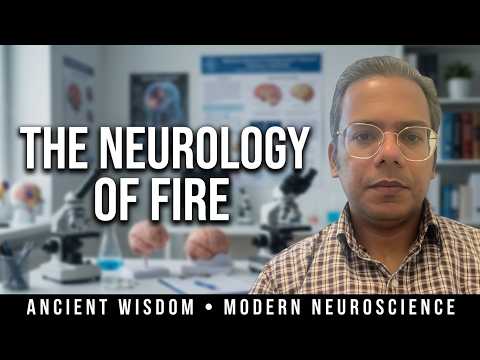
The Neurology of Fire
An exploratory conversation about fire, embodied experience, attention, symbolism, and the limits of neuroscientific analogy.
Watch on YouTube →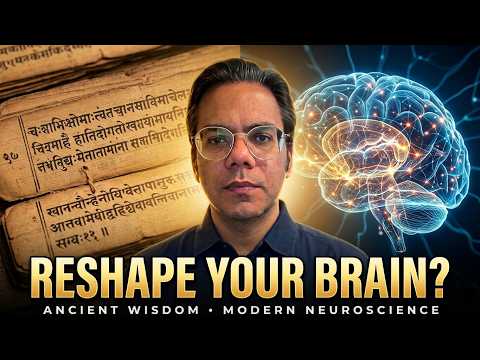
Reshape Your Brain? Arjuna, Cognition & Reframing
A psychology- and cognition-oriented discussion of Arjuna’s crisis before the war, using the Bhagavad Gītā to examine confusion, perspective, duty, and cognitive reframing.
Watch on YouTube →Collection III • Tradition / Śāstra / Culture
Hindu traditions, Purāṇa, ritual, festivals, recitation & lived practice
This collection is explicitly traditional and cultural. It includes discussions of Hindu identity and saṃskṛti, Purāṇic and scriptural themes, vrata and festivals, ancestral traditions, mantra, Sandhyā, Sanskrit recitation, and lived Hindu practice.
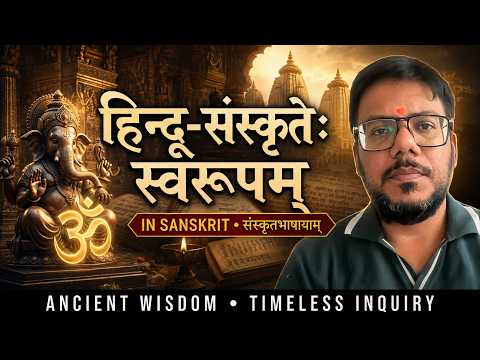
What Is Hindu Sanātanī Saṃskṛti?
What is Hindu culture? Dharma, karma, rebirth, āśrama, and the Hindu way of life — presented in Hindi, Sanskrit, and English.
Purāṇa, Itihāsa & Sacred Narratives
Purāṇic teaching, sacred narratives, cosmology, and traditional interpretation.
Browse related IvyPandit videos →Festivals, Vrata & Hindu Practice
Festival talks, vrata, pūjā, observance, and lived Hindu practice.
Browse related IvyPandit videos →Pitṛpakṣa, Śrāddha & Ancestor Traditions
Ancestor remembrance, śrāddha, tarpaṇa, Mahālaya, and related scriptural traditions.
Browse related IvyPandit videos →Gāyatrī, Sandhyā & Mantra Practice
Gāyatrī, Sandhyopāsanā, mantra, recitation, and contemplative practice.
Browse related IvyPandit videos →Sanskrit Recitation & Cultural Learning
Sanskrit recitation, verses, traditional learning, and cultural education.
Browse related IvyPandit videos →Explore the full IvyPandit channel
New lectures, shorter reflections, research discussions, Sanskrit and IKS material, and traditional Hindu cultural content continue to be added.
Follow IvyPandit
Invite Dr. Nishant K. Mishra for a Lecture
Selected IvyPandit themes can be developed into live or virtual lectures for universities, Sanskrit institutions, temples, professional organizations, conferences, and community audiences. Talks can be delivered in English, Hindi, or Sanskrit and adapted to the audience.
View speaking topics →Invite • Collaborate • Discuss
Scholar, scientist, practitioner, or organizer?
Write if a lecture connects with your textual expertise, research, institution, or community program.